The Basant 400 Ton Friction Screw Press is a mechanical-drive machine built with a flywheel-driven screw rather than a crank — friction discs spin the screw down under load, giving a slower, higher-force stroke. This configuration comes with a table size of 28″x28″ (711x711mm), a stroke length of 18″ (457mm), 10 strokes per minute, making it suited to forging, upsetting, coining and bolt-heading, where a slow, high-energy blow is needed rather than a fast punching stroke. Manufactured at Basant Mechanical Works’ Ludhiana facility since 1957, ISO 9001:2015 certified.
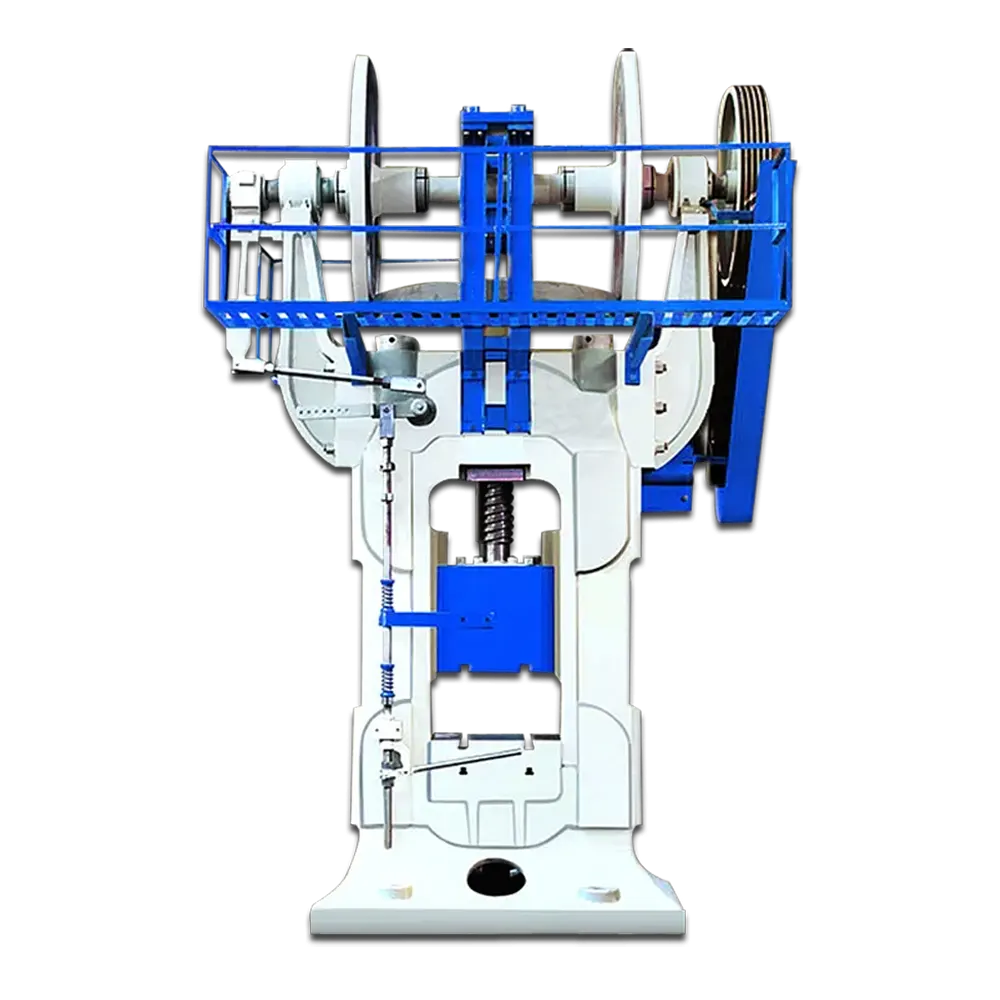
Friction Screw Press generates forming force through a flywheel-driven screw rather than a crank -- friction discs spin the screw down under load, giving a slower, higher-force stroke suited to forging, upsetting, coining and bolt-heading work.
400 Ton Friction Screw Press
400 Ton Mechanical Friction Screw Press — full specification table and FAQs on this page.
Technical Specification for 400 Ton Friction Screw Press
| Capacity in tons | 400 |
|---|---|
| Table size in mm | 28"x28" (711x711mm) |
| Stroke Length | 18" (457mm) |
| Stroke Per Minute | 10 |
| Bore in Table | 6" |
| Power Required | 40 HP |
| RPM | 960 |
Our Friction Screw Press is built with a heavy cast-iron frame, a precision-machined screw and nut assembly, and a friction-disc drive that converts flywheel energy into a controlled forging blow. This screw-drive design gives more forming energy per stroke than an equivalent-tonnage crank press, at the cost of a slower cycle rate.
Ask For PriceFAQ
What is a Friction Screw Press used for?
It's used for forging, upsetting, coining and bolt-heading, where a slow, high-energy blow is needed rather than a fast punching stroke.
How is a screw press different from a power press?
A screw press stores energy in a spinning flywheel and releases it through a screw, giving a slower but higher-force stroke; a power press uses a crank for a fast, fixed-stroke cycle.
What capacity range does Basant's Friction Screw Press cover?
Roughly 50 to 500 tons.
Related products
-
Ask For Price
Capacity in tons 200 Table size in mm 22"x21" (559x533mm) Stroke Length 14" (356mm) ₹1,000,000.00Add to cart -
Ask For Price
Capacity in tons 100 Table size in mm 19"x18" (483x457mm) Stroke Length 11" (279mm) ₹750,000.00Add to cart - Ask For Price
-
Ask For Price
Capacity in tons 300 Table size in mm 25"x24" (635x610mm) Stroke Length 16" (406mm) ₹1,250,000.00Add to cart